 Lightchainai
 governance
- last updatedLightchain AI’s DAO gives token holders a role in proposals, discussion, and voting on protocol upgrades, funding, and partnerships. On mainnet, DAO treasury actions go through LightChainGovernor and a TimelockController, while a 3-of-5 protocol Safe controls AIConfig. A decision’s effect depends on the action authorized and the network where it applies.
Which settings affect AI inference?
AIConfig stores inference parameters that, on mainnet, the protocol Safe can update within contract-enforced bounds. WorkerRegistry manages worker registration, staking, eligibility, and reputation, while JobRegistry manages sessions, job state, fee escrow, and dispute records.
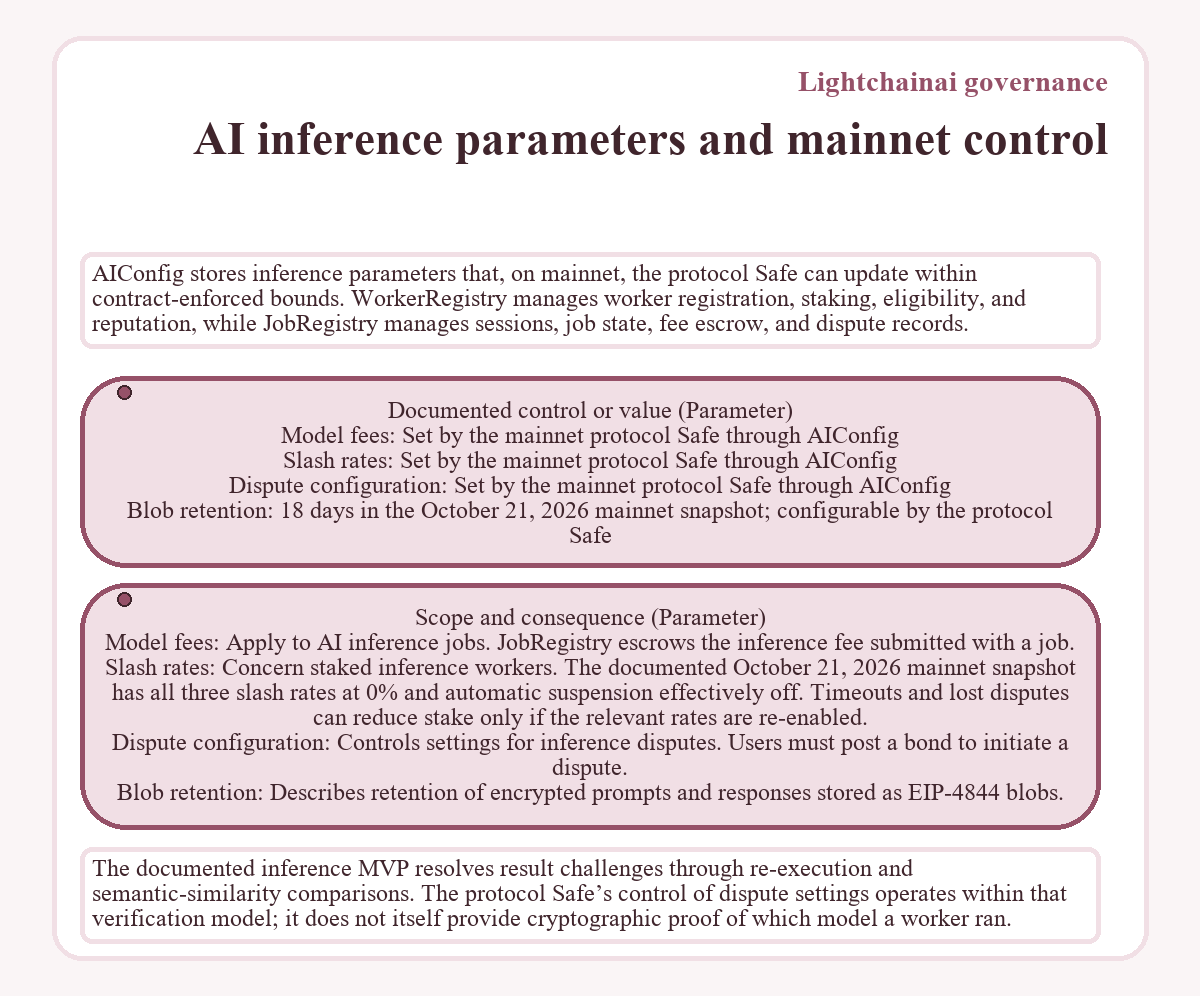
| Parameter | Documented control or value | Scope and consequence |
|---|---|---|
| Model fees |
Set by the mainnet protocol Safe through
AIConfig
|
Apply to AI inference jobs.
JobRegistry
escrows the inference fee submitted with a job.
|
| Slash rates |
Set by the mainnet protocol Safe through
AIConfig
|
Concern staked inference workers. The documented October 21, 2026 mainnet snapshot has all three slash rates at 0% and automatic suspension effectively off. Timeouts and lost disputes can reduce stake only if the relevant rates are re-enabled. |
| Dispute configuration |
Set by the mainnet protocol Safe through
AIConfig
|
Controls settings for inference disputes. Users must post a bond to initiate a dispute. |
| Blob retention | 18 days in the October 21, 2026 mainnet snapshot; configurable by the protocol Safe | Describes retention of encrypted prompts and responses stored as EIP-4844 blobs. |
The documented inference MVP resolves result challenges through re-execution and semantic-similarity comparisons. The protocol Safe’s control of dispute settings operates within that verification model; it does not itself provide cryptographic proof of which model a worker ran.
What else has the DAO considered?
The DAO’s Ethereum proposal history includes exchange liquidity, listing agreements and fees, and a treasury stablecoin operational buffer. It also marks proposals approving an engagement agreement with Quantum Counsel LLC and appointing it as administrator of the LCAI DUNA as executed. These decisions extend governance into treasury operations and organizational administration.
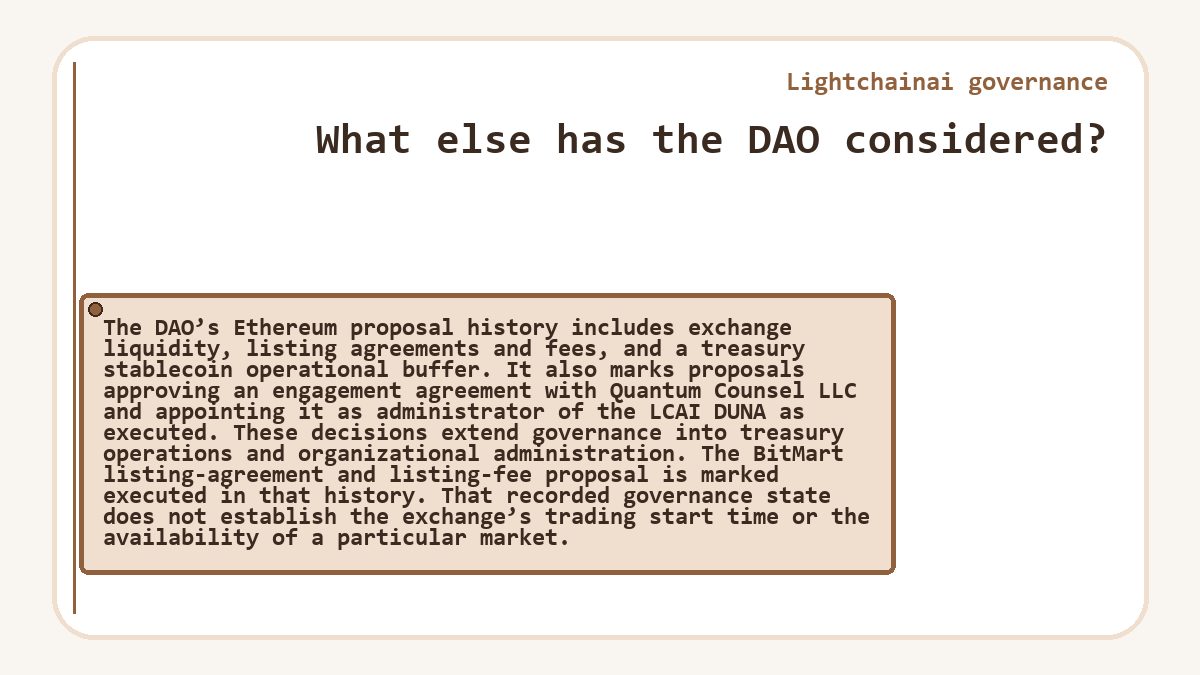
The BitMart listing-agreement and listing-fee proposal is marked executed in that history. That recorded governance state does not establish the exchange’s trading start time or the availability of a particular market.
Which network’s voting rules apply?
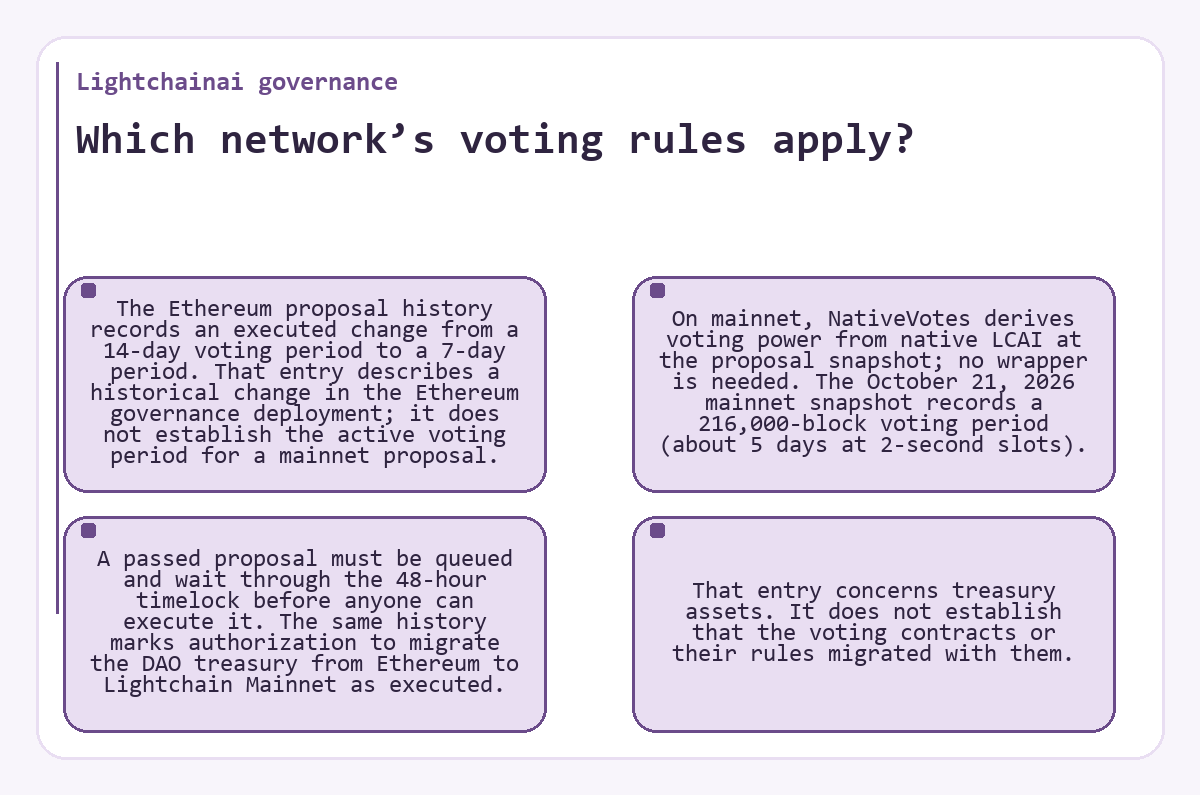
The Ethereum proposal history records an executed change from a 14-day voting period to a 7-day period. That entry describes a historical change in the Ethereum governance deployment; it does not establish the active voting period for a mainnet proposal. On mainnet, NativeVotes derives voting power from native LCAI at the proposal snapshot; no wrapper is needed. The October 21, 2026 mainnet snapshot records a 216,000-block voting period (about 5 days at 2-second slots). A passed proposal must be queued and wait through the 48-hour timelock before anyone can execute it.
The same history marks authorization to migrate the DAO treasury from Ethereum to Lightchain Mainnet as executed. That entry concerns treasury assets. It does not establish that the voting contracts or their rules migrated with them.